Why Barrier Three Can Be a Trap at Caulfield
Barrier three looks handy, but at tracks like Caulfield and Moonee Valley it can leave a horse stuck on the fence with no momentum.
Recorded August 2025 for Max Bet Ep 4: Saturday Wet Track Plays + Group 2 PB Lawrence Preview. Any figures mentioned are from that time.
Most punters look at a barrier draw and assume inside is good and wide is bad. It is not that simple. The shape of the track matters, and so does the way a race is likely to be run. At Caulfield over 1400 metres, I want horses on the pace, and I am wary of barrier three. Here is why.
The shape of the Caulfield 1400
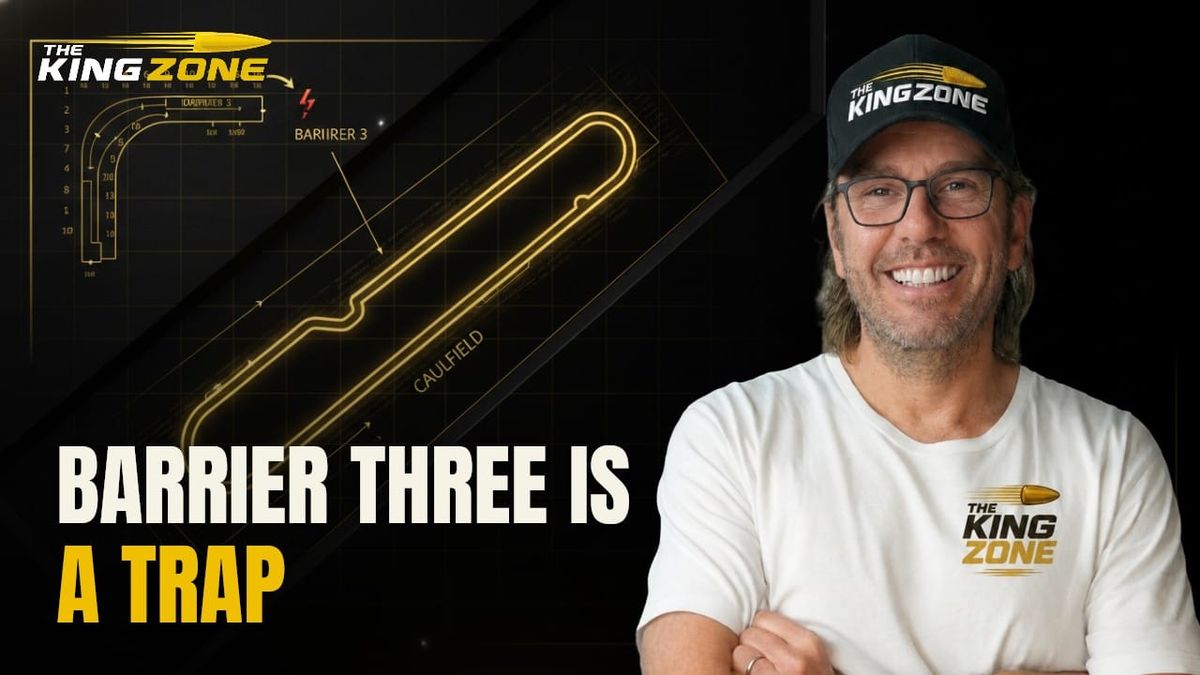
Start with the map. The 1200 metre start comes out of a chute, and there is quite a long run to the first and only turn. The 1400 also comes out of a chute, but from there you get a sweeping turn, and then the home turn. So the 1400 has two turns in it.
That matters. Traditionally at Caulfield the 1400 favours leaders. Distance wise, it has historically been the most leaderish trip at the track. With the rail out at nine metres I cannot find a lot of bias either way, but I still want to be with horses on the pace over that 1400 metre journey. If you are giving a start and asking a horse to work around two turns to get into the race, you are making the job harder than it needs to be.
Why barrier three can be a trap
Barrier three sounds like a good draw. It is close to the fence, you do not have to cross anything, and you can get cover early. The problem is what happens if you do not lead.
If there is pace drawn inside you, say in one and two, and your horse is not quick enough to hold the front, you end up three pairs back on the fence. That is an awful spot. You have no momentum, you cannot improve when you want to, and you are relying on luck for a gap to appear. Meanwhile the horses outside you are rolling forward with momentum and going past. By the time the run comes, the race is over.
That is why I look at the pace drawn inside a horse before I decide whether barrier three is a positive or a negative. If there is a bit of speed in one and two, I would rather be sitting one off the fence than trapped against it. The same thinking applies at Moonee Valley. Those are the tracks where barrier three can really hurt you if you are not leading.
Map the race, not just the draw
When I went through a 1400 at Caulfield, I had a horse drawn barrier ten that I expected to go forward, and another in barrier eight that needed to press forward to get a spot. The perfect result there was one-one. Then there was a horse in barrier three with a bit of pace inside it. That horse is best served sitting one off the fence, not buried against it.
There was not much pace in the race overall, so I was expecting a slow tempo. That makes on-pace horses even more valuable, and it makes a bad spot on the fence even harder to escape.
So do not read barrier three as an automatic tick. Look at where the speed is drawn inside it, look at how many turns the trip has, and work out whether that horse can actually get to a spot it can win from.
Every race on the card, rated, with Kingsley's selections and the speed maps behind them. Your first day is free, no card needed.
More from Kingsley
- How Barriers Decide Whether a Race Is Run Fast or Slow
- "How Much Does A Wide Barrier Really Cost A Horse?"
- Why Being Drawn Wide Is a Bigger Worry Than People Think
From the full video: Max Bet Ep 4: Saturday Wet Track Plays + Group 2 PB Lawrence Preview
Gamble responsibly. 18+. If gambling is a problem for you, call Gambling Help on 1800 858 858 or visit gamblinghelponline.org.au